A floating production base for ocean storytelling, marine research and the Escape to Pacific expedition.
Sailing Catamaran
The expedition catamaran is a central part of the Escape to Pacific project. It is not only a sailing vessel. It is designed to become a floating film production base, a diving platform, a research support hub, a communication centre and the long-term home of the international team during the ocean expedition.
Escape to Pacific will follow a team of filmmakers, marine biologists, divers, photographers and sailors as they travel from Europe across the Atlantic, through the Caribbean and Central America, and onward into the Pacific Ocean.
To tell this story properly, the team needs more than short production trips. It needs time, mobility, independence and the ability to live close to the ocean for long periods. The catamaran makes this possible.
Why a Catamaran
A catamaran is essential to the project because it allows the team to reach remote islands, coral reefs, coastal communities and marine environments that are often difficult or expensive to access with a conventional film crew.
It provides the flexibility to follow weather windows, return to locations when conditions are right, stay longer in important areas and work independently from large marinas, hotels or external production bases.
For Escape to Pacific, the catamaran will serve as:
- a floating film production base a diving and underwater filming platform
- a home for the core expedition team
- a guest cabin for selected experts, partners or invited personalities
- a media and communication hub connected to audiences and partners around the world
- a visible symbol of the long-term ocean mission behind Escape to Pacific
This approach allows the project to document the ocean from within the expedition itself — not as a short visit, but as a long-term journey.
A Floating Film Production Base
The catamaran will support professional documentary production in remote ocean regions.
The team plans to produce cinematic 4K documentary episodes, underwater sequences, aerial footage, photography, short digital content, expedition updates, interviews, behind-the-scenes material and immersive 360° / 180° content.
Living and working on board allows the production to stay close to the story. The team can film at sunrise, during storms, at anchor, underwater, during scientific observation, in local communities and throughout the everyday rhythm of expedition life.
This is especially important for wildlife and ocean storytelling. Many powerful moments cannot be scheduled. They must be lived, observed and captured when they happen.
The catamaran gives the team the time and proximity needed to create a deeper and more authentic documentary record of the ocean.
Supporting Marine Science and Conservation
Escape to Pacific combines documentary storytelling with marine science, conservation communication and public education.
The catamaran will support collaboration with marine biologists, local experts, conservation organisations, universities, island communities and research partners.
Its role may include supporting reef observation, underwater documentation, biodiversity photography, monitoring of fragile marine environments, interviews with scientists and local communities, and communication of conservation issues to wider audiences.
The project will focus on coral reefs, marine biodiversity, climate-related impacts, ocean warming, pollution, marine protected areas, island communities and the relationship between people and the sea.
The vessel allows the team to spend meaningful time in remote regions where these stories are unfolding.
The Planned Route
From there, the expedition will continue across the Atlantic to the Caribbean, with Saint Lucia planned as an important first base after the crossing.
The route will then move through selected Caribbean islands, toward Central America and the Panama Canal, before entering the Pacific Ocean.
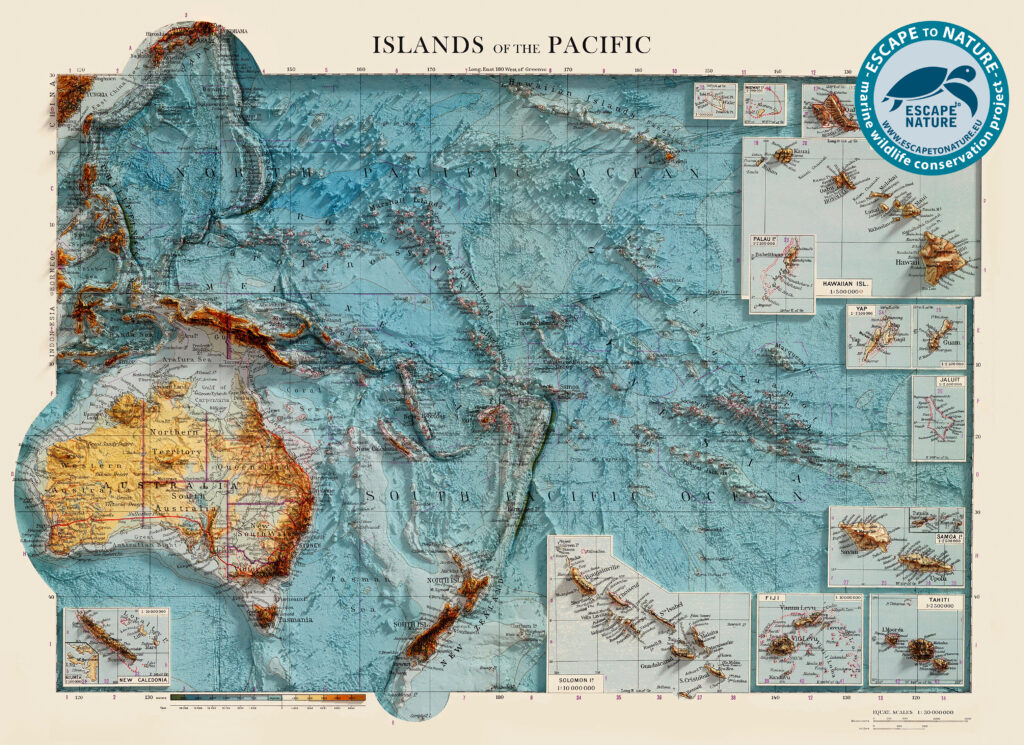
The first major Pacific locations are planned to include the Galápagos and the Marquesas, followed by further filming across French Polynesia, Fiji, the Cook Islands, Tonga, Samoa, New Caledonia, Vanuatu, the Solomon Islands and Papua New Guinea.
The route is ambitious but intentionally flexible. It will be shaped by weather, permits, scientific opportunities, local partnerships, safety, environmental conditions and the natural rhythm of island life.

Partnership with Lagoon and Altumare
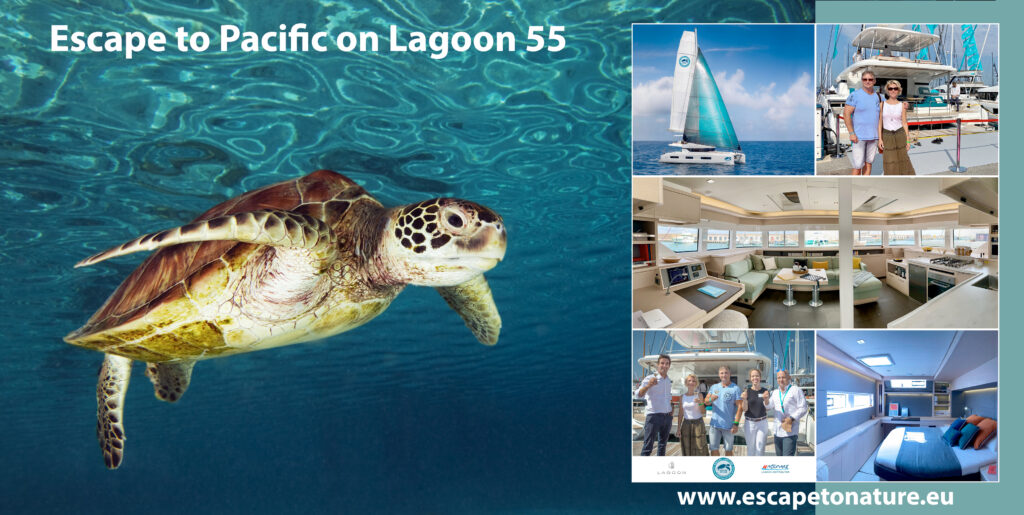
Escape to Nature has been in communication and cooperation with Lagoon Catamarans in France and Altumare, the official Lagoon representative.
The project and the cooperation between Lagoon and Escape to Nature were publicly presented at the Cannes Yachting Festival in September 2021. The original page already mentions this partnership and the presentation at Cannes Yachting Festival.
The final catamaran model and detailed ownership or financing structure will depend on the final production and investment arrangements. For this reason, Escape to Nature currently presents the vessel more broadly as an ocean-going production catamaran and long-range expedition platform for Escape to Pacific.
Life on Board
The catamaran will be home to a compact international team during long periods of filming and research.
The core team will include filmmakers, underwater camera operators, marine biologists, divers and experienced sailors. During the expedition, selected experts, scientists, local collaborators, partners and invited guests may temporarily join the team in specific destinations.
This human layer is important. Escape to Pacific is not only about distant islands and underwater landscapes. It is also about the people who dedicate their time, skills and energy to understanding and protecting the ocean.
Life on board will bring its own story: teamwork, uncertainty, discovery, responsibility, physical challenges and the emotional impact of living close to fragile marine ecosystems.
Immersive Ocean Experiences
The catamaran is both a creative tool and a tangible operational asset.
For broadcasters, streamers and production partners, it supports a distinctive long-term documentary format with strong visual identity.
For strategic partners, it provides a visible and authentic platform for ocean storytelling, conservation communication and global engagement.
For investors and private partners, it represents a real physical asset connected to a long-term media and expedition project.
The vessel is therefore not only a cost of production. It is part of the project’s structure, identity and long-term value.
A Platform for Partners
The expedition catamaran can create meaningful opportunities for selected partners.
Potential forms of cooperation may include production financing, technical support, marine equipment partnerships, camera and communication technology partnerships, diving equipment partnerships, sustainability and energy solutions, scientific collaboration, destination support, educational outreach or private investment.
Selected partners may benefit from professional visual content, behind-the-scenes stories, expedition updates, PR opportunities, educational materials and carefully integrated visibility within the broader Escape to Pacific project.
All partnership, investment or guest participation arrangements are handled individually and subject to appropriate legal, financial, production and safety documentation.
More Than a Yacht
The catamaran is the place where the story begins every morning.
It is where the team wakes up before diving, prepares cameras, studies weather, edits footage, meets guests, speaks with scientists, watches the horizon and lives the reality of the expedition.
For Escape to Pacific, the catamaran is more than transport.
It is the bridge between the ocean and the audience.
It is the home of the project.
Contact
For partnership, production, broadcast, investment or technical cooperation related to the Escape to Pacific expedition catamaran, please contact Escape to Nature.
Escape to Pacific — a cinematic ocean expedition powered by a floating production and research base.